
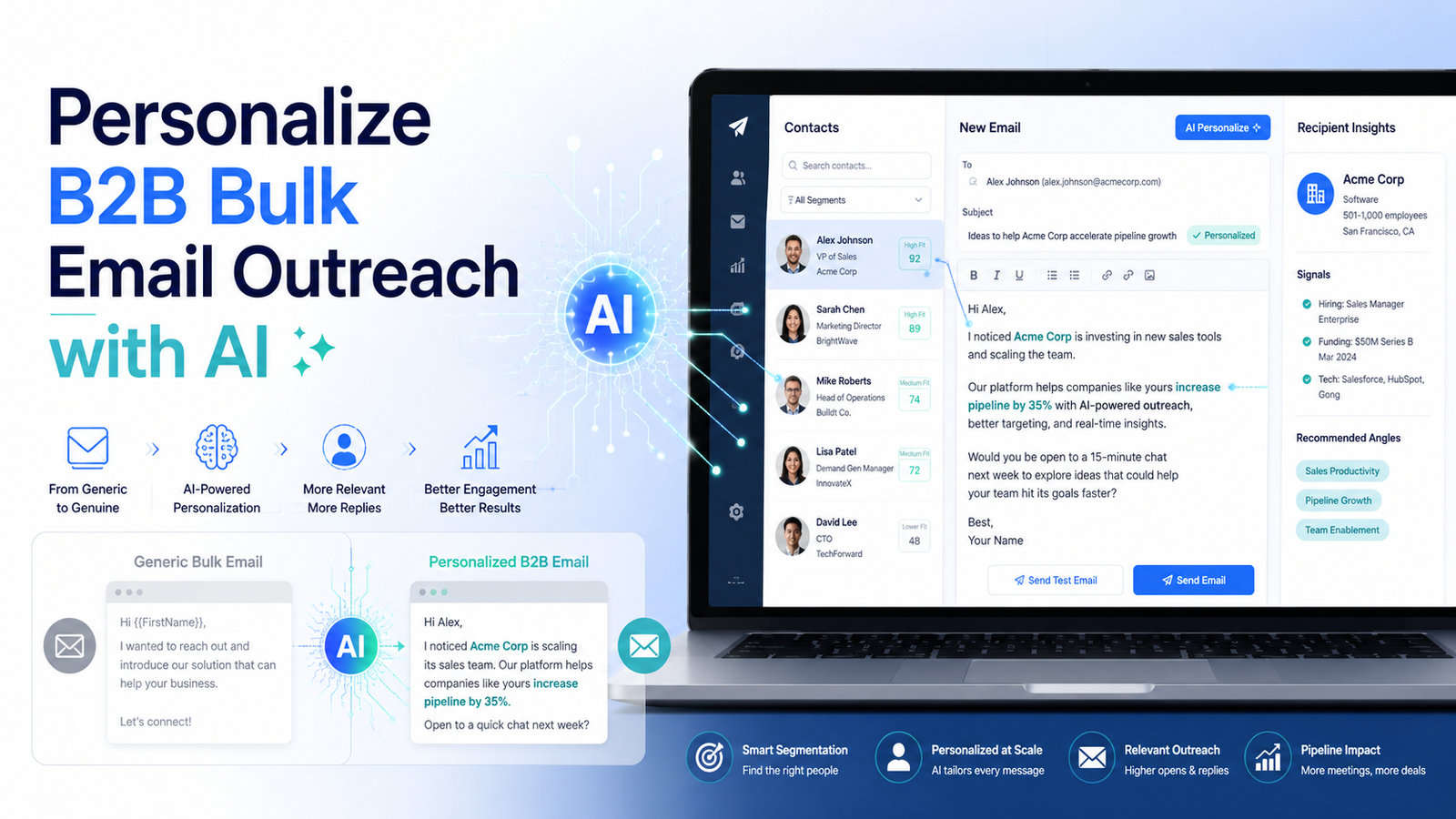
Bulk email outreach has a bad reputation, and much of it is deserved.
Everyone has received emails that begin with a generic compliment, mention the wrong company, or immediately launch into a sales pitch that has nothing to do with the recipient. These messages are easy to ignore because they feel automated, careless, and impersonal.
The problem is not necessarily the use of bulk email. The problem is sending the same message to hundreds or thousands of people without giving them a reason to care.
AI can help solve this problem, but only when it is used correctly. The goal is not to trick someone into believing that you spent an hour researching them. The goal is to make each email more relevant, specific, and useful.
Start with a Narrow Audience
Personalization begins before you write the email.
A common mistake is building a list that is too broad. For example, a list of “small business owners” could include dentists, software companies, construction firms, accountants, and restaurants. These businesses have very different problems, buying cycles, and priorities.
AI cannot rescue a campaign that targets everyone.
Instead, divide your prospects into focused groups. You might target:
- Personal injury law firms with fewer than 20 attorneys
- Roofing companies serving Southern California
- SaaS companies that recently hired a head of sales
- Marketing agencies that specialize in healthcare
- E-commerce companies running paid social campaigns
The narrower the audience, the easier it becomes to write an email that sounds relevant.
Give AI Useful Information
AI personalization is only as good as the information you provide.
At a minimum, your prospect list should include the person’s name, job title, company name, company website, and industry. Better campaigns may also include company size, location, recent hiring activity, services offered, technologies used, recent news, or social media information.
You can gather this data from company websites, LinkedIn, business directories, public databases, and prospecting tools. Some outreach platforms can automatically enrich a contact record with additional company information.
Once the data is collected, AI can use it to create a personalized opening sentence, identify a likely business problem, or adjust the message based on the recipient’s role.
For example, a generic opening might say:
“I help companies generate more qualified leads.”
A more relevant version could say:
“I noticed your firm focuses on employment law throughout Southern California. We help regional law firms generate consultation requests without relying entirely on referrals.”
The second message is still scalable, but it sounds like it was written for a particular kind of business.
Personalize More Than the First Line
Many AI outreach campaigns personalize only the opening sentence. The rest of the email remains unchanged.
This often creates an awkward transition. The first sentence mentions something specific about the recipient, but the next paragraph launches into a generic pitch.
Effective personalization should influence the entire message.
The recipient’s industry can determine which problem you discuss. Their job title can determine which benefit you emphasize. Company size can affect the type of offer you make. A small business owner may care about simplicity and cost, while a sales director may care about pipeline growth and team productivity.
You do not need a completely different email for every person. Instead, create several versions for different audience segments and let AI customize the details within each version.
Use AI to Find a Real Reason for Contacting Them
One of the best uses of AI is identifying a reasonable connection between the prospect and your offer.
Suppose you sell appointment-setting services. AI could review a company’s website and determine whether it relies on consultation calls, product demonstrations, estimates, or free assessments. The email can then reference the company’s actual sales process.
If you sell software, AI might identify the tools a company currently uses and explain how your product fits into that environment.
If you provide website services, AI might notice that a site loads slowly, has outdated messaging, or lacks a clear mobile call to action.
The observation does not need to be clever. It simply needs to be accurate and relevant.
Avoid shallow personalization such as complimenting a recent post or saying that you “love what the company is doing.” These lines are used so frequently that they often make an email feel more automated, not less.
Keep the Email Short
Personalization does not mean writing a long email.
Most cold prospects are not ready to read your company history, review a list of services, or study a detailed proposal. Your first email should create enough interest to earn a reply.
A strong B2B outreach email usually includes four elements:
- A relevant reason for contacting the person
- A problem or opportunity connected to their business
- A brief explanation of how you can help
- A simple question or call to action
AI can help shorten drafts, remove unnecessary language, and create variations for different audiences. However, you should review the results carefully. AI often adds too much enthusiasm, too many adjectives, or phrases that sound unnatural in a business email.
Simple language usually performs better.
Make the Call to Action Easy
Do not ask a cold prospect to commit to a 30-minute meeting before they understand why the conversation would be useful.
A smaller question can feel more natural:
“Would it be useful if I sent over a few examples?”
“Is improving outbound response rates a priority this quarter?”
“Are you currently handling this internally?”
“Would you be open to a brief overview?”
These questions make it easy for the recipient to respond without making a major commitment.
AI can choose a call to action based on the prospect’s role or stage of awareness. A company already using a competing service may be ready for a comparison. A company that appears unfamiliar with the solution may need educational information first.
Review Every AI-Generated Field
Automation can create embarrassing mistakes at scale.
Before launching a campaign, inspect a sample of the personalized emails. Check that company names are formatted correctly, observations are accurate, and sentences flow naturally into the rest of the message.
Pay particular attention to unusual businesses, companies with limited website information, and prospects with ambiguous job titles.
It is also wise to create a fallback sentence for cases where the AI cannot find enough reliable information. A simple industry-specific introduction is better than an incorrect personalized claim.
Protect Your Sending Reputation
Personalization will not matter if your emails are sent to spam.
Use verified email addresses, configure your sending domains correctly, limit the number of messages sent from each mailbox, and remove contacts who bounce or unsubscribe. Avoid misleading subject lines and make it clear who you are.
You should also provide a straightforward way for recipients to opt out of future emails. Good outreach is targeted and respectful. It should not depend on making it difficult for someone to say no.
AI Should Improve Relevance, Not Fake Familiarity
The best AI-powered outreach does not pretend that the sender has a personal relationship with the recipient.
It uses available information to answer a simple question: Why might this person care about this message?
When your audience is focused, your data is accurate, and your offer addresses a real business need, AI can help you send personalized emails at a much larger scale. The result is not just a better first line. It is a campaign that feels more relevant from the subject line through the final question.